
Why Comparing Jobs Across Companies Beats Single-Job Resume Optimization
Stop playing keyword whack-a-mole. Start building a real strategy.
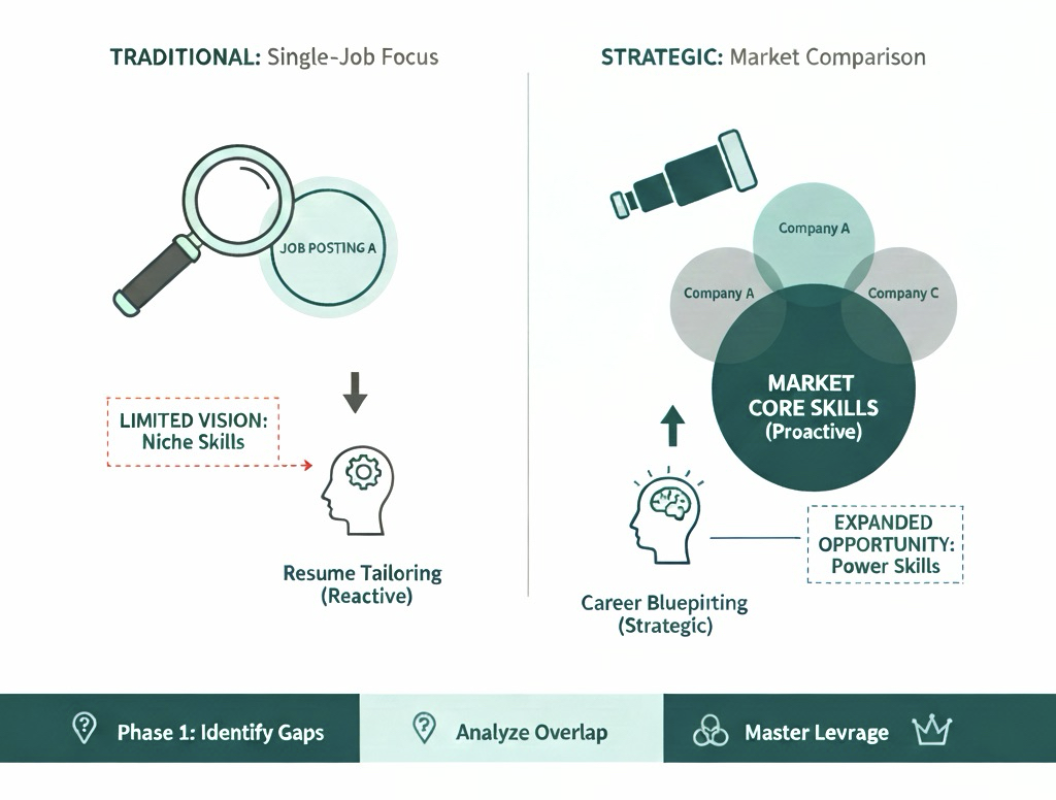
Figure 1: Comparing multiple job descriptions reveals skill patterns, table stakes, and gaps.
You've probably heard the advice countless times: tailor your resume for every job you apply to. Scan the job description, identify the keywords, weave them into your resume, and hope the ATS gods are pleased.
It sounds smart. It feels productive. But when you're applying to 20, 30, or 50 roles, this approach collapses quickly. You end up juggling a dozen resume versions, unclear about which skills truly matter, and quietly wondering if you're just guessing.
There's a better way. Instead of optimizing for one job at a time, compare multiple jobs side by side. The patterns you uncover will fundamentally change how you approach your resume.
The Problem with Single-Job Optimization
Most resume tools follow a standard playbook. You paste in a job description, upload your resume, and receive a "match score" based on keyword overlap. Hit 80%, and you're "good." Drop below 60%, and you're told to stuff in more buzzwords.
This creates three major strategic problems:
1. It keeps you reactive. Every new job description sends you back to the drawing board, with no unifying strategy behind your applications.
2. It offers no prioritization. It can't tell you which skills—Kubernetes versus Docker, for example—actually matter more for your target roles.
3. It optimizes for the wrong goal. Matching keywords doesn't mean you're presenting your strongest case. It just means you've satisfied a filter.
What Job Comparison Actually Reveals
When you analyze several similar roles across different companies, patterns emerge that no single job description can show you.
For example, if you compare Product Manager roles at companies like Stripe, Figma, and Airbnb, you stop treating each posting as a separate puzzle. Instead, you're analyzing a collective market.
The table stakes If four out of five roles mention cross-functional collaboration, that's a universal requirement you must demonstrate clearly.
The secondary priorities If three out of five mention data-driven decision making, it's important—but probably not your lead bullet.
The outliers If only one mentions a specific skill like SQL proficiency, it's not worth restructuring your entire resume around.
This is the difference between keyword matching and strategic positioning. You're no longer guessing—you're learning what your target market actually values.
How to Do This Yourself
You don't need fancy tools to start. A spreadsheet works fine.
Create columns for each job you're considering. Add rows for dimensions like technical skills, tools, experience level, and leadership expectations.
Then:
Highlight the patterns. Anything that appears in three or more roles is a must-have and should be featured prominently on your resume.
Identify the outliers. If only one company cares about a specific technology, treat it as company-specific context—useful for tailoring, not for redefining your core resume.
Bridge the gaps. If the market consistently asks for stakeholder management and your resume never uses those words—even though you've done the work—that's a problem. Make the experience explicit.
From Comparison to Smart Tailoring
This approach doesn't mean you stop tailoring. It means you tailor smarter.
Start by building a strong base resume optimized around the recurring patterns you've identified. This version reflects what most employers in your target roles care about.
Then, for each application, make small adjustments. Emphasize one project over another. Add a role-specific keyword. You're refining, not rewriting.
The difference is confidence. You know your base resume already covers what matters most, so every tweak is fine-tuning—not starting from scratch.
The Bigger Picture
Single-job optimization isn't wrong. It's incomplete.
By comparing roles across companies, you move from reactive to strategic. You stop guessing which keywords matter and start understanding what the market actually rewards. Your resume becomes stronger because it's grounded in real patterns, not individual quirks.
This approach scales. Whether you apply to 10 jobs or 100, you aren't working harder—you're working smarter.
AlignUp helps you compare job descriptions across companies instantly—so you can see skill patterns, identify gaps, and tailor your resume with confidence. Try it free today.